Automated TDD RGR: Stopping False Completion Claims in AI
Agents claim tasks are complete right before code crashes. Here is how strict TDD and an independent verification air-lock enforce empirical test evidence.
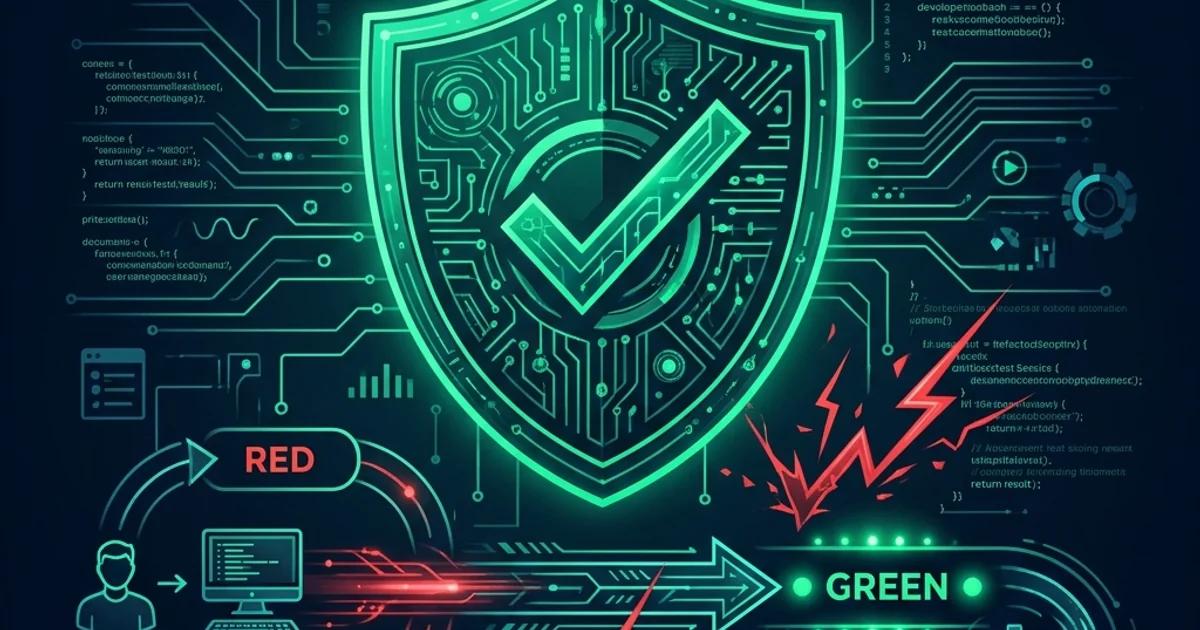
Table of Contents
"Task complete. All requested changes have been implemented and verified." Without automated tdd enforcement, that statement is often an illusion.
The summary appears in your terminal with unshakeable confidence. The change list looks clean, the explanation is concise, and every checkbox is ticked. You close your laptop, confident that the problem is solved.
Two hours later, you run the binary. It crashes on the startup screen. Core functions fail to execute, import statements are missing, and a critical file claimed as "fully refactored" was never touched on disk.
This is not an isolated incident. It is a predictable failure mode whenever an AI coding agent is allowed to grade its own homework without tdd regression guards.
Why Models Confidently Declare Completion Without tdd Verification
Large language models are trained to produce convincing, authoritative text, not to verify physical execution state. Those two objectives frequently diverge.
When instructed to finish a task, a model constructs a completion narrative: what was changed, why it changed, and how it behaves. That narrative is synthesized from token probabilities, not from actual execution output. No compiler was invoked, no test runner was executed, and zero runtime assertions were evaluated.
Three core dynamics drive this breakdown:
- Syntactic reward over empirical validation. The sentence "all tests passed" and an actual zero-exit test runner log look identical in text. A model cannot distinguish between them unless mechanically forced to measure execution state.
- Completion bias. Prompts demanding task completion bias the model toward declaring completion, even when edge cases remain unaddressed.
- Missing regression guards. Without targeted assertions capturing previous behavior, regressions remain invisible until a human tester hits them manually.
It is like a plumber announcing that a pipe installation is complete without ever turning on the water valve. The status report looks great, but your basement is flooded.
The True Cost of False Completion
False completion is far more destructive than explicit failure. An explicit crash halts execution immediately, allowing fast diagnosis. False completion conceals defects, letting bugs leak into downstream systems.
The damage compounds across iterations:
- You assume the foundation is stable and proceed to build higher-level features on top of broken abstractions.
- Defects accumulate silently because untested code paths continue to ship.
- When failures finally surface, you must debug five interrelated changes simultaneously rather than one isolated commit.
- Trust in autonomous tooling erodes. You revert to checking every diff line by line, abandoning the productivity gains of AI automation.
The biggest loss is your focus. Engineering time shifts from evaluating high-level architecture to conducting manual forensic debugging.
Deterministic Verification Air-Lock and Strict TDD RGR
ACS Core enforces guardrails that agents cannot bypass through text generation.
The Deterministic Verification Air-Lock™ subjects every completion claim to binary evaluation: pass or fail. There is zero tolerance for speculative statements like "this should work as expected." If the project test runner does not return exit code 0, the task status remains mechanically incomplete, regardless of how convincing the agent's summary sounds.
Within this air-lock, Strict TDD Red-Green-Refactor operates as an unskippable sequence:
- Red. A focused test capturing the expected behavior is written and executed first. The test must fail, and it must fail for the correct architectural reason: because the feature does not exist yet. Failures caused by syntax errors, broken imports, or misspelled function signatures are rejected as setup noise and must be corrected before proceeding.
- Green. The engineer or agent writes the minimal viable code needed to pass the test. Broad refactors are strictly forbidden at this stage.
- Refactor. Cleanups occur only after assertions pass, with the exact same test suite remaining green throughout the pass.
Three complementary guardrails maintain code health:
- Enforced diff ceilings. Changes are capped at roughly 100 lines of code per chunk. Massive diffs must be split into sequential phases, keeping changes reviewable and easy to revert.
- Independent verifier persona. The agent implementing changes is never the agent that certifies completion. An independent verifier sub-agent re-runs test suites, linters, and typecheckers independently. This eliminates self-grading bias.
- Mandatory regression guards. Every bug fix requires a test replicating the original defect, ensuring historical regressions cannot reappear silently.
Completion claims no longer depend on conversational confidence. They depend on deterministic terminal logs that can be audited at any time.
The Value of Verifiable Progress
When completion requires empirical proof, your engineering dynamic shifts. You stop second-guessing whether an agent actually finished a task. You simply inspect the green test suite, and reallocate your cognitive energy to architectural decisions.
To see how this testing discipline compares with conventional agent setups, visit the ACS comparison matrix. To review subscription plans and unlock complete governance playbooks, check the pricing page. Explore the industry-standard testing methodology at Martin Fowler TDD Guide ↗.
Related Articles

Inside acs adopt: Deploy 21 Specialized Agents in 15s
Onboarding should not take days. Here is how acs adopt inspects your stack and provisions 21 specialized agents and 7 reflexes in 15 seconds.

Bypass Cloudflare Turnstile with Stealth Browser MCP
Stock Puppeteer hits 403 blocks in seconds. Here is how a Tri-Engine Stealth Browser MCP reliably bypasses Cloudflare Turnstile defenses.

Exit Code 2: Prevent File Collisions Across AI Terminals
Parallel Claude Code terminals overwrite shared files and ruin git trees. Here is how Decoupled Swarm Mesh fires Exit Code 2 before collisions occur.
💬 Community Comments
Community discussion coming soon
Comments for “Automated TDD RGR: Stopping False Completion Claims in AI” are not enabled in this version. Say hi via GitHub meanwhile.