Wanted AI to write code, but spent hours tweaking configs instead?
Default setups eat 10,474 tokens just sitting idle. Your agent only has 43% context left. No wonder long sessions hallucinate.
ACS gives you total local control over Claude Code and Antigravity. Install in 2 minutes, and your agents run overnight without freezing while slashing idle tokens by up to 88%.
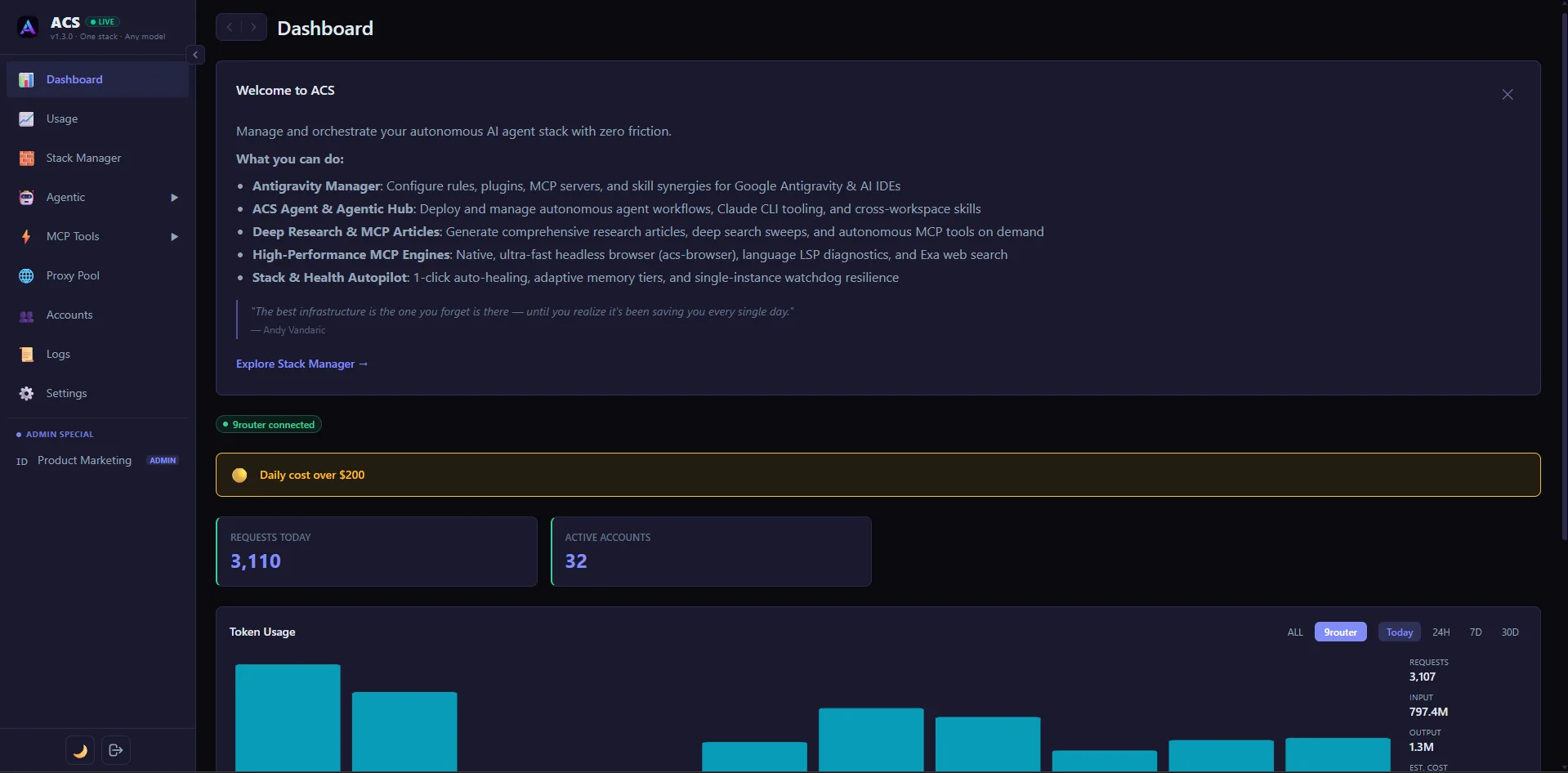
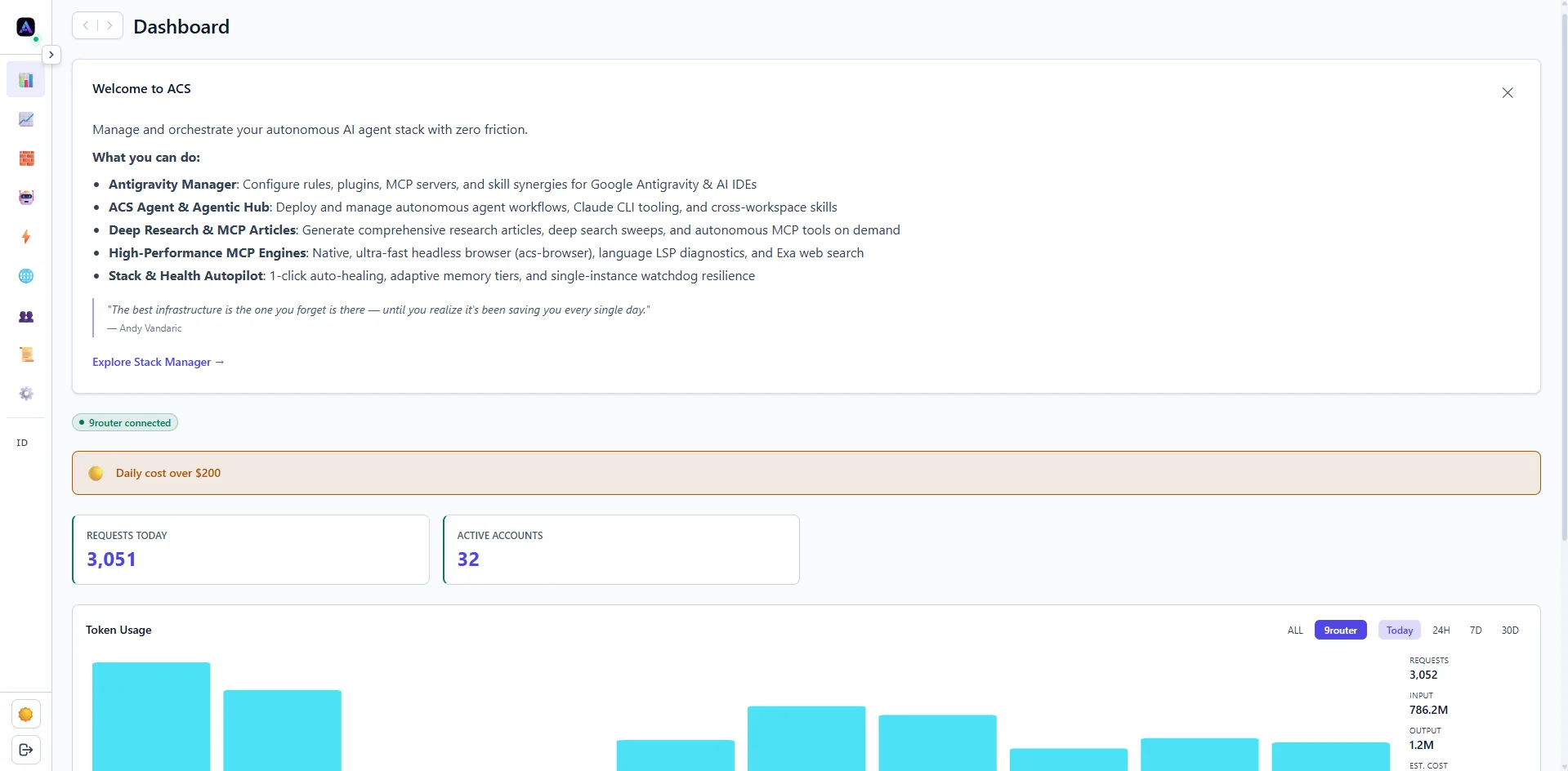
6 Pain Points That Drive AI Agent Developers Crazy
The bottleneck is rarely the AI model itself. Whether you are a senior dev or building solo projects, developer headaches almost always come from fragile local agent infrastructure.
Dumping Raw HTML Junk into Context
Your agent researches docs and ends up swallowing 70,000 tokens of raw HTML ads, tracking scripts, and navbars. Your API quota is gone in seconds, triggering context truncation right when reasoning counts.
56% Context Burned While Sitting Idle
Default setups force the LLM to memorize dozens of passive skill manifests. Before you type your first prompt, 10,474 tokens are already consumed just loading background instructions. Zero breathing room left.
Terminals Freezing Overnight
You leave your agent running overnight and head to sleep. You wake up to find the terminal hung for hours because an AI connection died or hit a rate limit. Zero progress, wasted prompt cycles.
Config Hell Across Multiple Tools
Connecting Claude Code, Antigravity Desktop, and IDEs is a nightmare. Config files are scattered everywhere. One missing comma, and your entire AI connection stack crashes.
Blocked by Modern Anti-Bot Firewalls
Stock headless browsers get blocked instantly by modern bot defenses when inspecting documentation. Your agent goes blind, failing to extract the exact technical references you need.
Dreading Tooling & CLI Updates
Update and risk breaking your entire workflow, or skip it and stay trapped with upstream bugs. One failed update and you are rebuilding from scratch because there is no 1-click rollback.
Where Does the 56% Burned Context Actually Go?
Every time a stock coding agent boots up, the system forces the LLM to ingest monolithic instruction files and dozens of background tool manifests. Whether your task needs them or not, they get packed into prompt memory every single turn.
This is where the 100% On-Demand architecture of ACS shines. Over 77+ skills stay dormant on your local disk, injected into context only when triggered. Idle background bloat drops to virtually zero.
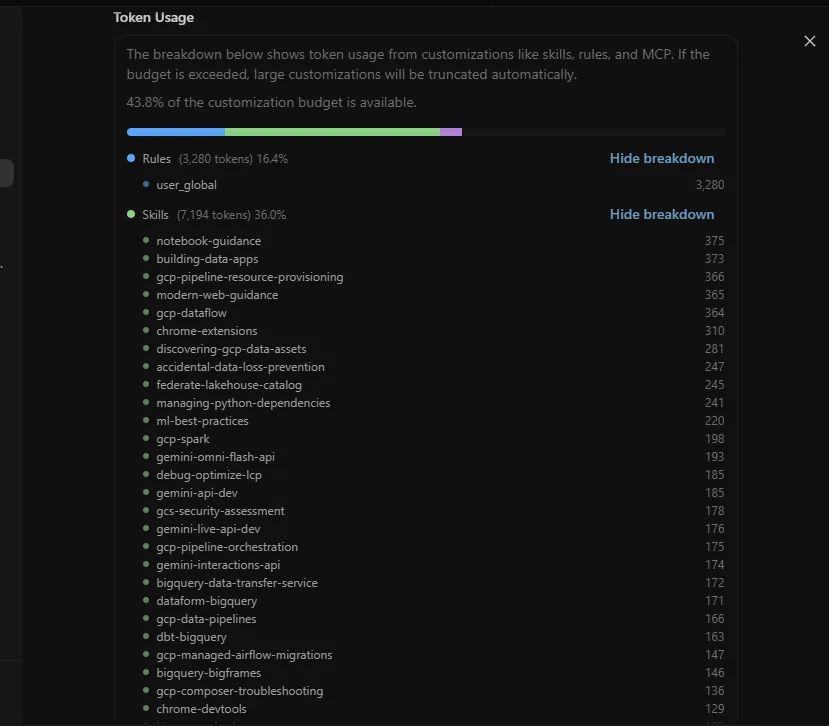
11,238 tokens vanish immediately on boot (Default skills 36.0% + Ruleset 16.4%). Your agent is suffocating before writing line one.
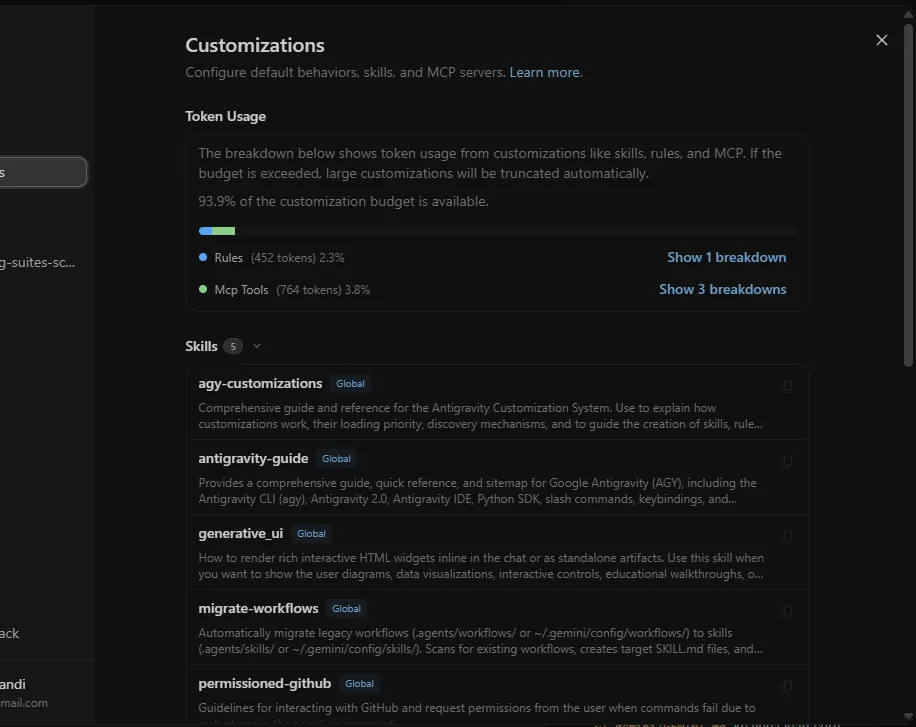
Default skill idle footprint drops to 0 tokens. Rulesets are compressed to 452 tokens via Lean Index. Productive context headroom expands by 2.14x.
Live Benchmark Audit (Antigravity & Claude Code)
Audited token measurements recorded on a standard 20,000-token context window.
| Setup Component | 1. Default Stock | 2. On-Demand Skills | 3. Full ACS Engine |
|---|---|---|---|
| Built-in Skills (Plugins) | 7,194 tokens (36.0%) | 0 tokens (0%) | 0 tokens (0%) |
| Rulesets (CLAUDE.md) | 3,280 tokens (16.4%) | 3,280 tokens (16.4%) | 452 tokens (2.3%) |
| MCP Tools Engine | 764 tokens (3.8%) | 764 tokens (3.8%) | 764 tokens (3.8%) |
| Total Idle Overhead | 11,238 tokens (56.2%) | 4,044 tokens (20.2%) | 1,216 tokens (6.1%) |
| Remaining Working Context | 43.8% (8,760 tokens) | 76.3% (15,260 tokens) | 93.9% (18,784 tokens) |
Deal-Maker Features for AI Power Users
Not just cosmetic wrapper scripts. This is a local architecture engineered to eliminate technical agent bottlenecks during large-scale autonomous coding projects.
Knowledge Articles Engine
Stock scrapers swallow messy raw HTML—a single webpage can eat 70,000 tokens! ACS compresses web noise into 1,500-token Markdown and caches it locally. Need the same docs tomorrow? It reads from instant local cache in 2ms with zero API cost.
Universal Agent Sync
Tired of editing scattered JSON files? One click synchronizes MCP ports, environments, and profiles across Claude Code, Antigravity, and IDEs with zero conflicts.
Self-Healing Router AI
Proxy dropped while you were asleep? ACS enforces a 3-Strike Circuit Breaker. If a router path fails 3 times, traffic shifts instantly to a healthy backup. Your agent keeps running.
Anti-Detect Stealth Browser
Way beyond a simple headless browser. ACS bundles a stealth Chromium engine with realistic OS fingerprints. Your agent extracts modern protected docs without triggering anti-bot firewalls or flashing console pop-ups.
Auto-Decomposer Rules
Got rulesets spanning hundreds of lines? On turn one, ACS decomposes massive rule files into a compact Lean Index. Per-turn prompt load drops by 95%, stopping agent amnesia.
Intelligent Account Balancer
Managing multiple AI provider accounts? The system automatically prioritizes accounts nearing quota reset so credits never expire unused. Seamless failover keeps coding uninterrupted.
Unified Kanban Hub
Track autonomous agent execution on an interactive local Kanban board. Task dependencies, transition logs, and Git commits are recorded cleanly in your cockpit.
Sovereign MAS Orchestration Engine
A multi-agent orchestration kernel built on 2-Tier Hub-and-Spoke architecture (depth=1) that blocks unbounded recursion and fork bombs. The 3-minute proactive watchdog detects silent worker loops and recovers them, while the compiled Go hook engine eliminates 150KB configuration drift across machines.
ACS is an Engine, Not a Shallow Plugin
Most tooling options are thin API wrappers. ACS functions like an on-site engineering manager: governing data flow, stripping memory waste, and shielding autonomous agent runs.
| Workflow Dimension | Default Stock Setup | ACS Control Engine |
|---|---|---|
| Web Extraction & Doc Research | Raw HTML dump (40k-70k tokens burned per page) | Dense Markdown + Local Cache (-90% tokens, 0ms revisit) |
| Idle Context Footprint | 11,238 tokens wasted before line one of code | 1,216 tokens (100% On-Demand, 89.1% idle savings) |
| Multi-Agent Synchronization | Editing dozens of scattered JSON files, port conflicts | 1-Click Auto-Sync across Claude Code, Antigravity & IDEs |
| Connection Failure Recovery | Terminal hangs for hours, overnight run fails silently | 3-Strike Circuit Breaker + automatic healthy fallback |
| Modern Web Bot Protection | Standard headless scrapers blocked by 403 Forbidden | Multi-Tier Anti-Detect Stealth Browser Engine |
| Instruction Overhead (Ruleset) | Monolithic rules ingested every turn (3k-9k tokens/turn) | Auto-Decomposed Lean Index (150-300 tokens, 95% savings) |
| Recovery from Broken Tool Updates | Hours rebuilding broken configs from scratch | 1-Click Instant Rollback directly in local cockpit |
| Data Privacy & Sovereign Runtime | Configs and project data routed through external servers | 100% Local Machine (Sovereign Runtime, zero cloud leaks) |
| Multi-Agent Orchestration | Unbounded recursion risks fork bombs flooding the machine | 2-Tier Hub-and-Spoke architecture capped at depth=1 |
| Pre-Planning Audit Integrity | Hallucinated memory trusted as-is with no re-verification | Read-only Auditor runs live AST inspection against disk |
| Worker Background Supervision | Silent loop hangs freeze execution for hours, no warning | 3-minute proactive watchdog with automatic recovery |
| Code Verification | Self-verification bias: agents grade their own output | Air-Gapped Hard Gate 3 independent verifier |
| Runtime Hook Architecture | 150KB script deployments drift across machines | Pure Thin Shim + compiled Go hook engine (zero drift) |
Why I Built ACS
I didn't build ACS from a market research spreadsheet. This system was born out of personal frustration every night delegating complex coding sprints to Claude Code and Antigravity.
I wanted to leave my agents running overnight while I slept. But I would wake up to find the terminal frozen for hours because a proxy died. When I checked the bills, thousands of tokens had evaporated—not on code reasoning, but on memorizing dozens of unused background skills.
I got sick of tweaking endless JSON files and watching API meters spin out of control. So I architected a sovereign local engine: Stateless MCP, Zero-Idle-Tokens, and Self-Healing Routing.
I run this exact setup every day to supervise autonomous agents on my own machine. Now you can spin up the same battle-tested architecture in 2 minutes without repeating weeks of trial and error.
What Happens After You Secure Your License?
No waiting around, no complicated manual setups. You are up and running in 3 straightforward steps:
Pick a Tier & Secure License
Complete your transaction instantly. Your license key and Member Portal credentials unlock immediately with zero manual wait time.
Run the 1-Line Installer
Paste a single command into your terminal (PowerShell on Windows, cURL on macOS/Linux). The script configures all binaries and daemon paths automatically.
Launch Dashboard & Start Coding
Open the local ACS dashboard in your browser. Click Auto-Sync to connect Claude Code or Antigravity. Your agents are primed for autonomous overnight runs.
One-Time Investment, Save Millions on API Tokens Every Month
Secure your license now before early bird pricing increases. All tiers include lifetime access to updates, cross-platform binaries, and technical support.
Select License Tier
One-time payment. No subscriptions, no hidden fees.
Frequently Asked Questions
Clear, transparent answers to the most common questions about ACS architecture and autonomous agent execution.
Are my source code and API keys safe? ↓
Does it support Windows, macOS, and Linux? ↓
I run Claude Code and Antigravity together. Is setup complicated? ↓
What if an upstream tooling update breaks my workflow? ↓
How does licensing and future updates work? ↓
Build Your Autonomous Agent Cockpit Today
You pay top-tier API pricing for AI agents to write high-caliber code—stop letting fragile default environments throttle them. Secure your ACS license today and supercharge your local workflow.